
Low testosterone in men should not be diagnosed from fatigue, reduced motivation, or one abnormal blood test alone. Before testosterone replacement therapy (TRT) is considered, symptoms need to fit the clinical picture and testosterone levels should be consistently low on properly timed testing.
That distinction matters because testosterone changes throughout the day, symptoms can overlap with many other health problems, and a low result may have an underlying cause that deserves evaluation before treatment begins. Current Endocrine Society guidance recommends diagnosing hypogonadism only when compatible symptoms or signs occur together with consistently low testosterone concentrations.
At Lifestyle Doctor Wellness, our approach to testosterone care starts with evaluation rather than assuming that every symptom requires TRT. Our testosterone service includes assessment of symptoms, health history, total and free testosterone when appropriate, and ongoing monitoring when treatment is selected.
What Matters Before TRT: Symptoms, Repeat Testosterone Testing, and the Cause of Low Levels
A proper evaluation for low testosterone in men looks at several factors together rather than relying on symptoms or a single laboratory result. The process typically starts by identifying symptoms that may be consistent with testosterone deficiency, confirming low testosterone with properly timed repeat testing, and then investigating why the level is low. Additional hormone tests, medical history, fertility goals, and baseline safety markers can also help determine whether testosterone replacement therapy (TRT) is appropriate for the individual.
Which Symptoms Can Be Associated With Low Testosterone?
Low testosterone can affect sexual function, reproductive health, physical function, mood, and energy, but the symptoms are not equally specific.
Symptoms and signs associated with male hypogonadism can include:
- reduced sex drive
- fewer spontaneous erections
- erectile dysfunction
- reduced sperm production or infertility
- reduced energy
- decreased muscle mass
- difficulty concentrating
- irritability or depressed mood
- breast enlargement or tenderness
- smaller testes
- hot flashes when testosterone is very low
The Endocrine Society emphasizes that symptoms alone cannot establish a diagnosis because many are nonspecific. Fatigue, low motivation, mood changes, trouble concentrating, and reduced physical performance can occur for reasons unrelated to testosterone.
That is why the question is not simply, “Do I have symptoms of low testosterone?”
The more useful question is:
Do the symptoms, repeated hormone measurements, health history, and additional clinical findings point toward true testosterone deficiency?
Is One Low Testosterone Test Enough Before TRT?
No. A single low testosterone measurement generally should not be used by itself to diagnose testosterone deficiency or decide on TRT.
Testosterone levels fluctuate, including across different times of day. Confirm suspected hypogonadism with repeated morning fasting total testosterone measurements. The diagnosis should be based on at least two early morning fasting tests together with symptoms.
The American Urological Association (AUA) uses total testosterone below 300 ng/dL on at least two separate early morning measurements, together with relevant symptoms or signs, as its diagnostic framework for testosterone deficiency.
A number therefore needs context. A testosterone value of 290 ng/dL on one test does not automatically mean that TRT should begin. The result should be confirmed, interpreted against the laboratory’s method and reference range, and considered alongside symptoms and other findings.
When Does Free Testosterone Matter?
Total testosterone is generally the starting measurement, but free testosterone may also be clinically useful in selected situations.
The Endocrine Society recommends accurate assays for both total and free testosterone and specifies that free testosterone should be considered when indicated rather than used automatically as a replacement for total testosterone testing.
This is another reason we avoid reducing testosterone evaluation to a single number. At Lifestyle Doctor Wellness, our testosterone evaluation may include both total and free testosterone as part of individualized laboratory assessment.
Why Are LH and FSH Important After Testosterone Is Found to Be Low?
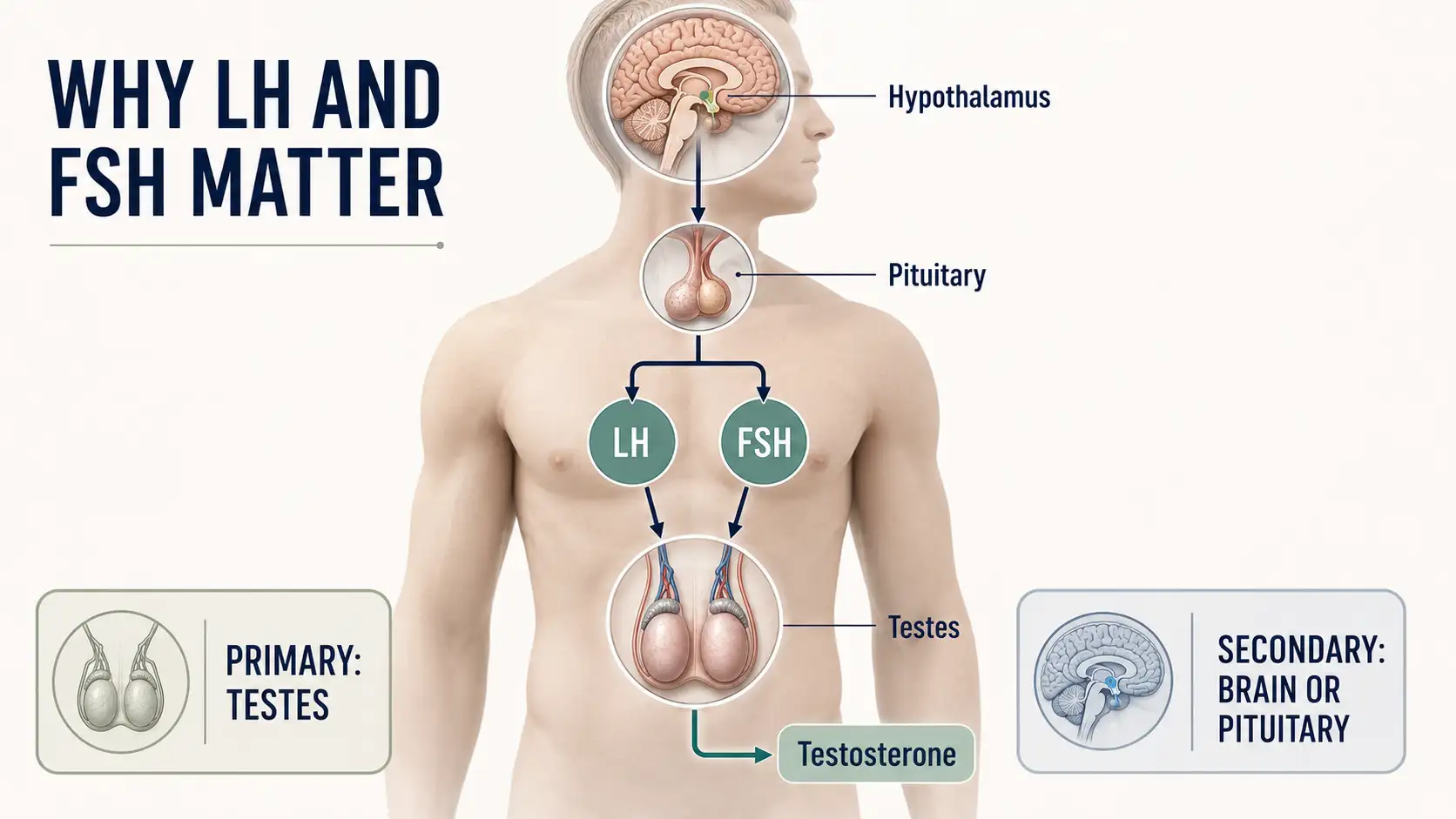
Finding low testosterone answers only one question. The next question is why it is low.
The brain and testes communicate through the hypothalamic-pituitary-gonadal system. Two important pituitary hormones in this process are:
- LH, or luteinizing hormone
- FSH, or follicle-stimulating hormone
The Endocrine Society recommends measuring LH and FSH in men with confirmed hypogonadism to help distinguish primary hypogonadism, where the problem is primarily at the testicular level, from secondary hypogonadism, where signaling from the hypothalamus or pituitary may be involved.
This distinction can change what should be investigated next.
When Can Prolactin Become Relevant?
Prolactin can be important when testosterone is low and LH is low or inappropriately normal.
The AUA recommends measuring prolactin in men who have low total testosterone combined with low or low-normal LH. Persistently elevated prolactin can warrant additional evaluation because pituitary disorders are among the possible causes.
This illustrates an important principle in testosterone care:
The objective is not merely to raise the testosterone number. It is to understand the clinical pattern producing that number before deciding how to manage it.
Why Check Hemoglobin and Hematocrit Before TRT?
Some laboratory testing is performed not to diagnose low testosterone, but to determine whether testosterone treatment can be used safely and monitored appropriately.
One important example is hemoglobin and hematocrit.
The AUA recommends measuring both before offering testosterone therapy because testosterone can increase red blood cell production. The guideline advises further evaluation when baseline hematocrit is elevated rather than automatically starting TRT.
The Endocrine Society similarly lists elevated hematocrit among conditions in which testosterone treatment should not be started without addressing the clinical issue.
This baseline value also provides something to compare with later blood tests if therapy begins.
Does PSA Matter Before Testosterone Therapy?
Prostate assessment can be part of the pre-TRT decision, depending on age, risk, medical history, and the patient’s individual situation.
The AUA diagnostic pathway includes PSA testing in men age 40 and older after testosterone deficiency has been confirmed and before proceeding to treatment. The Endocrine Society also recommends appropriate prostate cancer risk assessment and shared decision making about monitoring in relevant age and risk groups.
PSA should not be viewed in isolation either. An abnormal result may require additional evaluation rather than an automatic assumption about what it means.
Why Does Fertility Need to Be Discussed Before TRT?
For a man who wants children, fertility goals are an important part of the treatment decision.
The Endocrine Society recommends against starting testosterone therapy in men who are planning fertility in the near term. Testosterone treatment can suppress sperm production, so reproductive plans should be discussed before therapy begins.
This conversation is especially important for younger men who may focus primarily on fatigue, libido, gym performance, or a testosterone number without considering future fertility.
Could Something Else Be Contributing to the Low Result?
A low testosterone result does not explain its own cause.
Testosterone may be affected by disorders involving the testes, hypothalamus, or pituitary, and levels can also be influenced by health conditions, medications, severe illness, nutrition, sleep disorders, obesity, and other clinical factors. Further evaluation should therefore focus on identifying the reason for confirmed testosterone deficiency rather than immediately treating the laboratory value.
This fits the broader approach we use at Lifestyle Doctor Wellness. Dr. Marina Fest, DNP evaluates hormonal health alongside medical history, lifestyle factors, previous laboratory results, metabolic factors, and other relevant systems before developing an individualized care plan.
When Does TRT Become a Reasonable Conversation?
TRT becomes a more appropriate clinical discussion when several pieces line up:
- Symptoms or signs are compatible with testosterone deficiency.
- Low testosterone is confirmed on repeat properly timed measurements.
- The possible cause has been evaluated.
- Important safety factors and baseline laboratory results have been reviewed.
- Fertility goals and treatment risks have been discussed.
- There is a plan for follow-up and laboratory monitoring.
The FDA emphasizes that testosterone is a prescription treatment and its current safety information continues to require appropriate medical selection and monitoring. In 2025 the FDA also required class-wide labeling concerning increased blood pressure, while subsequent 2026 labeling updates revised other testosterone warnings and limitations.
TRT therefore should not be approached as a general energy booster or a treatment based solely on age or performance goals.
Get the Diagnosis Clear Before Treating the Number
The most important result before TRT is not one particular laboratory number. It is the combined clinical pattern.
Symptoms establish why testing matters. Repeated morning testosterone measurements establish whether low levels are consistent. LH, FSH, and sometimes prolactin can help clarify the source of the problem. Hemoglobin, hematocrit, prostate assessment when appropriate, fertility goals, and the wider medical history help determine whether treatment is suitable and how it should be monitored.
At Lifestyle Doctor Wellness, Dr. Marina Fest, DNP provides individualized testosterone evaluation and treatment planning based on laboratory data, symptoms, lifestyle, and health history rather than using the same TRT protocol for every patient.
If you have symptoms that may be related to low testosterone or already have an abnormal testosterone result, you can schedule a consultation to review the complete picture before deciding whether testosterone replacement therapy belongs in your care plan.
Frequently Asked Questions
What testosterone level is considered low in men?
The AUA uses total testosterone below 300 ng/dL, confirmed on at least two separate early morning measurements and accompanied by compatible symptoms or signs, as its diagnostic framework. Laboratory methods and clinical context still matter.
Can I have low testosterone symptoms with a normal testosterone result?
Yes, because symptoms such as fatigue, low mood, reduced concentration, and sexual concerns are not specific to testosterone deficiency. Other explanations may need to be considered when testosterone testing does not confirm persistent low levels.
Should testosterone be tested in the morning?
Yes. Guidelines recommend early morning measurements because testosterone varies during the day. The Endocrine Society recommends confirming suspected hypogonadism using repeated morning fasting total testosterone measurements.
What blood tests may be checked before TRT?
Evaluation commonly starts with repeated total testosterone testing. Depending on the clinical situation, free testosterone, LH, FSH, prolactin, hemoglobin, hematocrit, and PSA in appropriate men may also be relevant.
Can TRT affect fertility?
Yes. Testosterone therapy can suppress sperm production. Men who are planning fertility should discuss this before treatment, and the Endocrine Society recommends against starting TRT when fertility is planned in the near term.