
Eating a healthy diet does not guarantee that every nutrient measured in your blood will stay within an adequate range. Food intake is only one part of nutrient status. Your body also has to absorb the nutrient, transport it, store or use it appropriately, and keep up with ongoing losses or increased requirements.
This is why someone can regularly eat iron-rich foods, animal products containing vitamin B12, or vitamin D-containing foods and still have low laboratory results. Persistent deficiencies deserve more than the assumption that you simply need to “eat better.” The reason iron, vitamin B12, or vitamin D remains low can differ substantially from one nutrient to another.
Why Healthy Food Intake and Healthy Blood Levels Are Not Always the Same Thing
A healthy diet provides important nutrients, but adequate intake does not always guarantee adequate blood levels. Nutrient absorption, ongoing losses, medications, and individual health factors can all affect whether iron, vitamin B12, or vitamin D stays within a healthy range.
Why Can Iron Stay Low Even When You Eat Iron-Rich Foods?
Low iron is a good example of why nutrient status is not simply an intake problem.
Your body maintains iron through a balance between how much iron is absorbed and how much is lost. If losses consistently exceed absorption, iron stores can decline even when iron is present in the diet.
Blood loss is one important reason. Menstruating women, particularly those with heavy menstrual bleeding, have an increased risk of iron deficiency. Gastrointestinal blood loss can also contribute in some patients. Frequent blood donation can reduce iron stores as well.
Absorption also matters. Certain gastrointestinal conditions, including celiac disease, Crohn’s disease, and ulcerative colitis, as well as some gastrointestinal surgeries, can increase the risk of iron deficiency because of malabsorption, dietary restrictions, or gastrointestinal blood loss.
This means the clinical question should not always be:
“Am I eating enough iron?”
It may also need to include:
- Am I absorbing the iron I eat?
- Am I losing iron somewhere?
- Have my body’s requirements increased?
- Is inflammation affecting the way iron is being handled?
Simply increasing food intake may not answer those questions.
Can Iron Be Low Before Hemoglobin Becomes Abnormal?
Yes. Iron deficiency develops in stages. Iron stores can become depleted before anemia appears. During an earlier stage of iron deficiency, ferritin and available iron can decline while hemoglobin remains within the normal range.
That is why a normal hemoglobin result does not necessarily provide a complete picture of iron status.
Ferritin is commonly used to assess stored iron, while other measurements can provide additional context. Ferritin also has an important limitation because inflammation can increase it, potentially complicating interpretation. Healthcare providers therefore often evaluate several laboratory findings rather than relying on one number.
Persistent low iron should be evaluated before assuming that an iron supplement alone solves the problem. Excess iron can also be harmful, so supplementation should not be treated as automatically appropriate for every person with fatigue or suspected deficiency.
Why Can Vitamin B12 Stay Low Despite Eating Meat, Eggs, or Dairy?
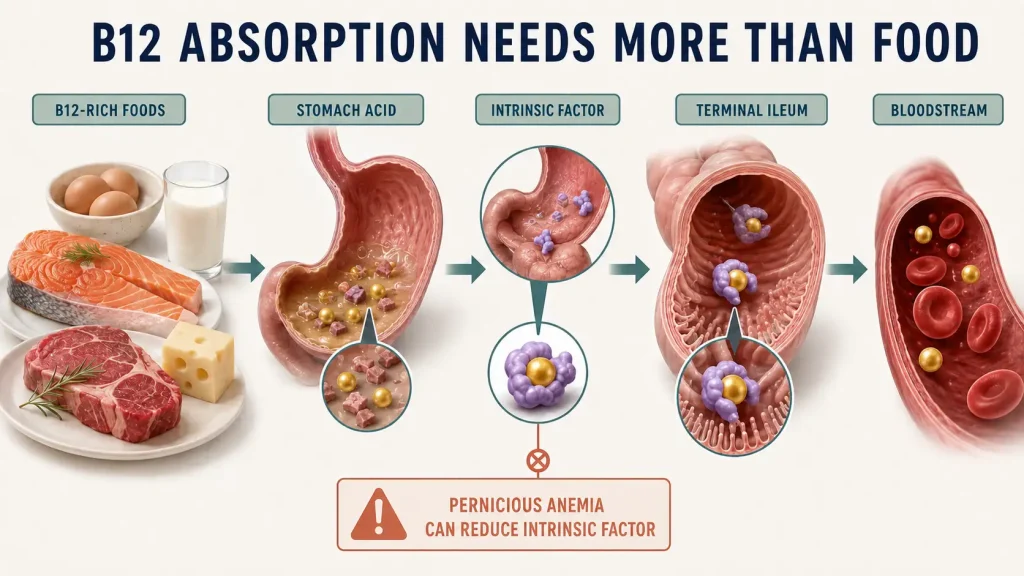
Vitamin B12 deficiency can occur even when dietary intake is adequate because B12 requires a specific absorption process.
Vitamin B12 in food is attached to protein. Stomach acid first helps release it. The vitamin then binds to intrinsic factor, a protein produced in the stomach, before it can be absorbed.
A problem at any important step can reduce absorption.
For example, pernicious anemia is an autoimmune condition in which the body cannot produce sufficient functional intrinsic factor. People with this condition can have difficulty absorbing vitamin B12 despite consuming B12-containing foods.
Gastrointestinal surgery and other conditions that interfere with absorption can also contribute to B12 deficiency.
So a person can have a diet that looks nutritionally adequate while the vitamin is simply not reaching the bloodstream efficiently.
Can Medications Affect Vitamin B12 Levels?
Yes, certain commonly used medications can affect B12 status.
The NIH Office of Dietary Supplements notes that prolonged use of gastric acid inhibitors, including proton pump inhibitors, can interfere with the release and absorption of food-bound vitamin B12.
Metformin, commonly used for diabetes and prediabetes, can also reduce vitamin B12 absorption and lower serum B12 concentrations.
This does not mean someone should stop either medication because a B12 result is low.
Instead, medication history becomes part of the clinical evaluation. A healthcare provider can determine whether additional testing, monitoring, dietary changes, or treatment is appropriate.
Is a Serum B12 Test Always Enough?
Not always. Serum or plasma vitamin B12 is commonly used as the initial measurement, but borderline results can require more context.
The NIH identifies methylmalonic acid, or MMA, as a sensitive marker that can help confirm vitamin B12 deficiency when serum B12 results fall into an uncertain range. MMA itself also has limitations because kidney function and age can affect its level.
This illustrates a broader principle:
A nutrient laboratory value needs interpretation, not just classification as high or low.
Symptoms, medical history, medications, gastrointestinal health, other laboratory findings, and the specific test used can all matter.
Why Can Vitamin D Stay Low Even With a Good Diet?
Vitamin D is different from both iron and B12 because diet is not its only major source.
The body can produce vitamin D when skin is exposed to ultraviolet radiation from sunlight, while relatively few foods naturally contain substantial vitamin D. Fortified foods provide much of the dietary vitamin D consumed in the United States.
Therefore, someone can follow an otherwise nutritious diet and still have a low vitamin D result if their overall vitamin D exposure or absorption is insufficient.
Factors associated with lower vitamin D status can include:
- limited sun exposure
- reduced skin production with increasing age
- darker skin pigmentation
- conditions that interfere with fat absorption
- obesity
- previous gastric bypass surgery
Because vitamin D is fat soluble, gastrointestinal conditions that reduce fat absorption can also reduce vitamin D absorption. NIH guidance specifically identifies conditions such as celiac disease, Crohn’s disease, ulcerative colitis, and certain liver disorders as examples.
Why Can Body Composition Matter for Vitamin D?
Vitamin D status can also be influenced by how the body distributes and stores the vitamin.
People with obesity tend to have lower circulating 25-hydroxyvitamin D, the form generally measured to assess vitamin D status. NIH guidance explains that larger amounts of subcutaneous fat can sequester more vitamin D, which can affect circulating concentrations.
This does not mean that obesity automatically causes vitamin D deficiency or that everyone with a higher body weight needs the same supplement dose.
It means body composition can be one of several variables a clinician considers when interpreting a persistently low result.
What Should Be Evaluated When Nutrient Levels Keep Coming Back Low?
When a nutrient remains low despite a seemingly adequate diet or supplementation, the next step should be understanding the pattern behind the result.
Depending on the nutrient and individual history, a clinical evaluation may consider:
- actual dietary intake
- gastrointestinal symptoms
- absorption problems
- menstrual or other blood loss
- previous gastrointestinal surgery
- medication use
- inflammation
- body composition
- sun exposure
- previous supplement use
- related laboratory markers
- whether the original deficiency was ever fully corrected
These factors should not be assumed to apply to every patient.
At Lifestyle Doctor Wellness, Dr. Marina Fest, DNP, uses a broader functional medicine evaluation that reviews medical history, lifestyle and stress factors, digestive and hormonal health, previous laboratory findings, and other relevant information. When clinically appropriate, the practice also lists micronutrient testing among the specialized testing options it may use.
The purpose is not to order every available test. It is to determine why a particular finding keeps recurring and which additional information is actually useful.
Should You Just Take More Supplements When a Level Is Low?
Not automatically. If a supplement has not corrected a deficiency, simply increasing the amount without understanding the reason can miss the real problem.
With iron, for example, persistent deficiency could reflect continued blood loss or malabsorption. With B12, impaired absorption may matter more than dietary intake. With vitamin D, absorption, sun exposure, body composition, or other factors may influence the result.
Supplements can also have risks. High doses of iron can produce gastrointestinal effects and, at very high amounts, serious toxicity. Excessive vitamin D intake can also be harmful.
Supplement choice and dosage should therefore reflect the nutrient, laboratory findings, clinical history, and reason the level is low.
Look Beyond Food Intake When a Deficiency Keeps Returning
A healthy diet remains an important foundation, but nutrient intake is not the same as nutrient status.
Iron can remain low because of ongoing blood loss, inadequate absorption, increased requirements, or problems involving iron storage and availability. Vitamin B12 depends on stomach and intestinal processes that can be disrupted by certain diseases, surgeries, and medications. Vitamin D depends on dietary intake, skin production, absorption, and other individual factors.
If your iron, B12, or vitamin D repeatedly comes back low despite eating well or taking supplements, the useful question is no longer simply “What should I eat?”
It is “Why isn’t my level improving?”
At Lifestyle Doctor Wellness, Dr. Marina Fest, DNP can review your symptoms, laboratory history, diet, medications, digestive health, and other relevant factors to determine whether a broader functional medicine evaluation is appropriate.
Frequently Asked Questions
Can you be nutrient deficient even with a healthy diet?
Yes. Adequate food intake does not guarantee adequate absorption or blood levels. Gastrointestinal disorders, medications, blood loss, increased requirements, and other individual factors can contribute to nutrient deficiency despite a nutritious diet.
Why does my iron keep dropping after supplements?
Persistent low iron can occur when iron losses continue or absorption is impaired. Heavy menstrual bleeding, gastrointestinal blood loss, gastrointestinal disorders, and some surgeries are recognized contributors. The underlying reason should be evaluated rather than assuming more iron is always the answer.
Can stomach problems cause low vitamin B12?
Yes. B12 absorption depends on stomach acid and intrinsic factor, and certain gastrointestinal conditions or surgeries can interfere with the process. Pernicious anemia can also prevent effective B12 absorption.
What blood test is used for vitamin D?
Vitamin D status is generally evaluated by measuring 25-hydroxyvitamin D [25(OH)D] in the blood. The result should be interpreted within the patient’s clinical context rather than used by itself to explain nonspecific symptoms.
Why is my B12 still low after eating foods that contain it?
B12 can remain low when the body cannot adequately release or absorb it from food. Pernicious anemia, gastrointestinal surgery, gastric acid-reducing medications, and metformin are among factors that can affect B12 status.